Posts

Showing posts with the label 2015

Geographical features: Jidda / Dyke (Dike)
Image
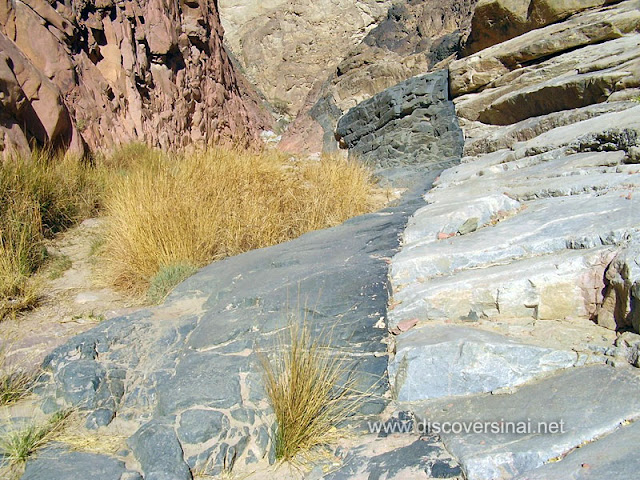
Originally posted on February 7, 2015 The whole southern tip of the Sinai Peninsula is a mountainous area, while the High Mountain Region proper, sometimes called the Central High Mountains, is the area in the middle around the town of St. Katherine. (See Google Earth screenshots below.) Up to 80% of the massif is granite of different types formed as far back as 600 million years, but there are also mountains that are made of newer, about 10 million year-old black volcanic rock. Sandstone and limestone are found north of the mountainous tip, forming surrealistic rock formations, sandy plains and eroded layered plateaus. In the mountainous area red granite and black volcanic mountains are often found together, as we can see with the Jebel Safsafa-Mt. Sinai, the Jebel Raba-Jebel Ahmar-Mt. Katharina or the Jebel Abu Mahashur-Jebel Abbas Basha ranges. In each case much of the mass of the mountains is made of hard and smooth red granite, but the famous peaks are actually softer crumbling bl...
Top 10 Tourist Attractions in South Sinai

Image
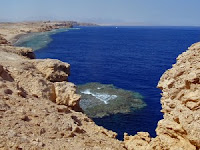
Originally posted on November 16, 2015 South Sinai features more attractions than most people think, and not all is under water. Known mostly for its Red Sea resorts, coral reefs and great diving, there is a lot to see in the interior too. Following are the 10 best known tourist attractions, the must-see places in South Sinai. 1. Ras Mohamed National Park Located near the resort city of Sharm el Sheikh, Ras Mohamed was the first National Park in the Sinai. It is famous for its underwater life and coral reefs, and so is usually visited for snorkeling and scuba diving, either by car or boat. It is a pleasant spot even if you are not into water sports. It is the southernmost point of the Sinai Peninsula and there are a number of beaches in little cute bays, as well as lookout points. Most tour operators organise programs to Ras Mohamed. >>> See photos 2. Blue Hole The Blue Hole is one of the most famous diving spots in Sinai, found near Dahab. It is submarine sinkhole, around 130...

Saving a Tribe’s Honour by the Bedouin Fire Test

Image
Originally posted on November 22, 2015 It’s a beautiful story about a Bedouin tribe’s honour and a very unique, ancient ritual that is practiced by the Bedouin, the Ordeal by Fire . It is one of those rare cases where a Bedouin writes about their own culture, not an outsider: the story is told by the son of the Sheikh whose tribe was involved in the case. The son, Salim Alafenisch, went on to study in Europe, and now lives and works in Germany. Unfortunately his books, including this one about the Fire Test, are only available in German, but here is the story in a few words. The story starts in the Negev desert, before the 1967 Arab-Israeli war. In an area that was peaceful at the time someone gets shot and killed near the place the tribe of Salim lived. The footprints of the perpetrator were tracked by specialists from an independent tribe, who confirmed they didn’t lead to Salim’s settlement. Despite this, the victim’s tribe accuses Salim’s tribe of murder and want revenge. To keep t...

Bisha – the Ordeal by Fire of the Bedouin

Image
Originally posted on May 28, 2015 The Bisha (Bisha’a) is a unique ritual practiced by the Bedouin tribes of the Sinai and Negev for the purpose of lie detection when one is accused of a serious crime but there is no proof. The ritual consists of the accused being asked to lick a red-hot metal spoon three times. His tongue is then inspected by the official who presides over the ceremony – the Bishari (or Mubasha) – and by the designated witnesses of the ritual. If the person undergoing the ritual is found to have a scarred or burnt tongue, he is found guilty. There is no way appealing the result and all have to accept the outcome and pay the fines as agreed beforehand. Sounds medieval, the ritual is still practiced today. I know several people who went through the fire test in recent years. The Bisha was described in a 1931 British publication, based on the the story of Austin Kennett, an Administrative Officer for the Egyptian Government in Sinai: “The trial by ordeal is employed to se...

The 10 Best Mountains in the Sinai

Image
Originally posted on February 22, 2015 How do you define the best mountain? The highest or the most famous? The toughest or the one with the best view? A mountain can be significant for various reasons, so it is difficult to choose the Top 10. The High Mountain Region – easy to guess – features many of the best mountains in the Sinai, but some of the highest peaks are actually found outside of this relatively small area contained within the circular dyke around St. Catherine. In fact, most of South Sinai is mountains, peak after peak. Called a jebel in Arabic, you could also argue what a mountain is… Is a big sandstone ridge a mountain? What about a plateau? Whatever the answer is, many of these geographical formations are very impressive. And any big hill or small mountain, or any elevated point in fact, provides a unique view. In this Top 10 only those mountains are listed that are relevant for visitors: some are right on the main tourist path, others are a bit off, but all these pl...

Bedouin tent in the past and today

Image
Originally posted on June 11, 2015 The Bedouin used to be pastoralist nomads and so they had to be mobile and lived in tents. Today, at least in the Sinai, most Bedouins are settled, but there are still a handful of old people who refuse to go in a brick house and prefer to live in tents. After rains, however, when pasture is plentiful, many people move out with their herds to their grazing lands and the old tents are back in use again. But the most likely places where visitors can see a traditional Bedouin tent are tourist establishments, either along desert safaris or in the camps on the coast, where it is used as a communal gathering place for guests.  The tents are made by hand of goat and sheep hair, so they are fairly expensive, but provide an ideal shelter in the desert. Its loosely woven material lets air come in and the smoke out, so the tent is pleasant in summer; however, when it rains, the fibers get swollen and the tent becomes waterproof. Once visiting a friend in Wad...